

The topic of effective working has been of interest to us not just since the days of working from home. Sensible time management has always been a major topic.
Sure, everyone has had the following feeling: you spend the whole working day at your computer and yet you hardly get anything done. You may have sent a lot of emails, made phone calls and perhaps even ticked off several items on your to-do list, but you often haven't produced any truly outstanding or even innovative output. Why is that?
We spend too much time doing unimportant and unproductive things. It is estimated that we spend more than two hours per working day doing unproductive work, and some estimate the proportion to be much higher! This work is known as fake work and shallow work. Of course, many of these things still have to be done. But it is worth taking a very close look and considering where you can make savings in order to optimize your time management.
Fake work refers to all the things at work that feel and look like work, but in reality are not. Real work moves the company forward, fake work does not.
Deep work - "A process of performing professional activities [...] in a state of distraction-free concentration that pushes cognitive abilities to their limits. These efforts create new value, improve your skills and are difficult to replicate." -Cal Newport
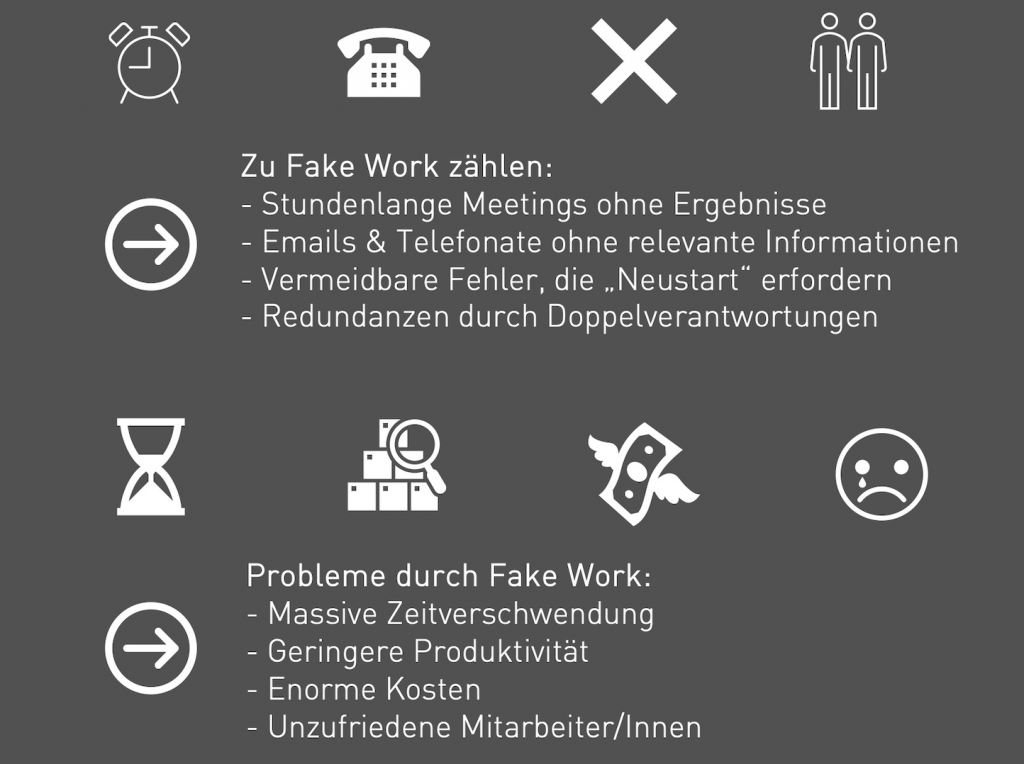
The high level of wasted time reduces productivity and results in enormous costs. In the long term, employee dissatisfaction increases.
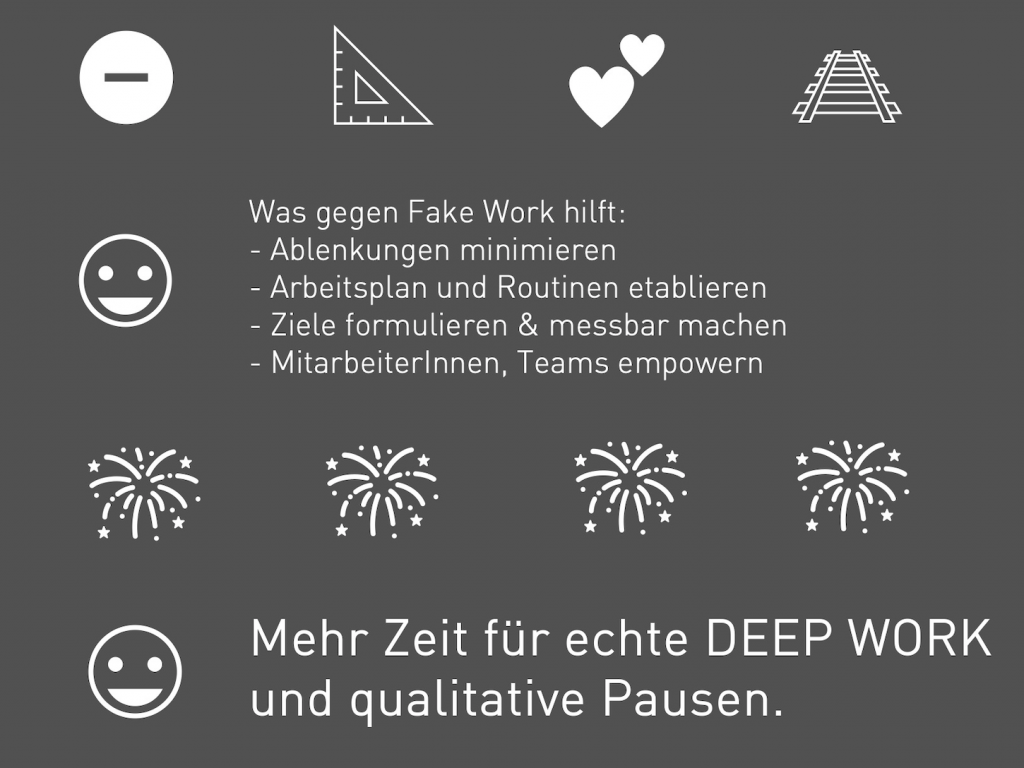
It is impossible to avoid fake work altogether. Reducing it increases productivity, lowers costs and increases profits .
This creates space for deep work phases and leads to satisfaction and motivation at all levels!
A WIN WIN spiral is created .
Is thatexactly your topic? Then our coaching Time and self-management is the right thing for you.
Get all the important information about the course content, schedule, and registration. Upon request, we can tailor this information to the training program you're already interested in.
You need to load content from reCAPTCHA to submit the form. Please note that doing so will result in data being shared with third-party providers.
More InformationYou are currently viewing placeholder content from Turnstile. To access the actual content, click the button below. Please note that doing so will result in data being shared with third-party providers.
More InformationYou are currently viewing placeholder content from reCAPTCHA. To access the actual content, click the button below. Please note that doing so will result in data being shared with third-party providers.
More Information