
The correct use of time is considered one of the most valuable skills - both in the private and professional sphere. Managers in particular must make the best possible use of the time available to them in order to move the company forward with the tasks that are relevant to them. It is therefore important to recognize: Which tasks should only be on my desk, which can I delegate and what is completely superfluous. Apply the Pareto principle and you will succeed in setting priorities and perfecting your time management.
As responsibility grows, so does the to-do list on the desks of most decision-makers and managers. Leadership tasks are added, while at the same time operational tasks must be performed and important decisions made that influence the future of the company. If you don't have good time management, you'll end up working a 7-day week, missing out on family, leisure time and your own needs, and quickly burn out.
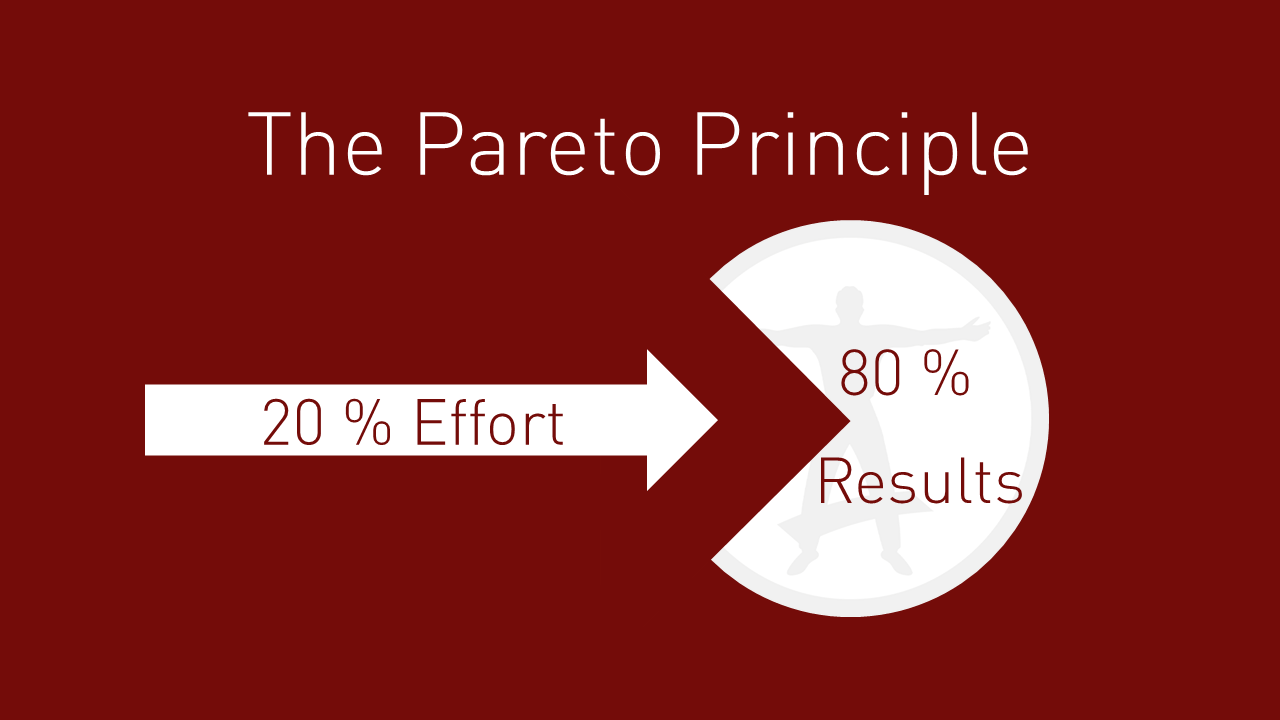
| Who developed the Pareto Principle? The rule also known as "80:20" was developed by the Italian Vilfredo Pareto, who noticed that 80% of the income from his country was earned by 20% of the population. He gradually generalized this finding and applied it to economic life. |
So the goal is to accomplish as much as possible with as little time as possible. The idea behind it: One of the biggest mistakes in time management is to invest a lot of time in thoroughly completing tasks that either don't need to be done at all, or at least don't need to be done by you personally. The Pareto Principle helps to set priorities, delegate tasks or eliminate them altogether.
The principle can also be applied to time management:
Conversely, this means that the remaining 80% effort is often spent on superfluous activities or excessive perfectionism, or simply takes up too much time.
The great benefit in applying the Pareto principle is that you recognize the tasks that can be completed with 20% effort and solve 80% of the problems. This requires a deeper analysis of which processes in the company cause which effort. The ultimate goal is to spend the most time on the most important tasks and to achieve the maximum effect with the least effort.
In order to apply the Pareto Principle in practice, tasks on your desk need to be prioritized. One effective way is to prioritize using ABCP tasks. The principle sounds simple in theory, but in practice it poses challenges for users because transitions between individual tasks can be fluid. With a little practice, however, prioritizing tasks in everyday work can make an important contribution to the success of the Pareto principle.
Managers often make the "mistake" of wanting to do everything themselves. As a result, too many tasks end up on their own desks and there is a great danger that important things are left undone because too much time is wasted on things that the employee could also do. Prioritizing tasks helps to maintain an overview.
A-tasks are important and urgent tasks that must be completed immediately. They cannot be delegated or postponed. Maximum efficiency is achieved by completing these tasks. When defining A-tasks, maximum discipline is required, as almost all tasks that land on your own desk are classified by others as extremely important and urgent.
Tips for setting the A tasks:
A-tasks almost always have a deadline and more or less severe consequences if they are not completed in a timely manner by the responsible person. A typical example is the response to a complaint from the most important customer received in the morning. In addition, A-tasks can usually be completed comparatively quickly - they are not long-term projects. Ideally, these tasks are done right at the beginning of the day to ensure that all A-tasks are accomplished. In addition, most people's concentration is higher in the morning.
The goal: Prioritize A-tasks and complete them yourself in a timely manner.
B-tasks usually end up on the desk of managers and decision-makers because they are important for the company. However, this does not necessarily mean that they have to be completed personally by the managers. Rather, the goal should be for managers to empower their employees to solve B-tasks on their own. An example might be submitting a grant application. This task is important and must also be completed within a certain period, but not necessarily by you personally.
B tasks are characterized by the fact that they are usually projects that have to be completed over a longer period of time. A typical example is the creation of a financial plan or a marketing campaign. In practice, these B tasks are often neglected. As they are usually left on a desk, they are only noticed when there is a proverbial fire and they become an A task because the competition is hot on the heels of your own company.
The goal: Delegate B tasks wherever possible so that they don't get left behind.
The C tasks also have their raison d'être - but not on your desk. One example is issuing a reference. Supervisors are obligated to do this, but the task does not have to be completed within a few hours, nor is it necessarily a matter for the boss. The job reference can also be written by the human resources manager or another competent employee, who may be in an even better position to assess job performance because he or she has been in direct contact with the employee or trainee. Invoice verification is also a typical C-task that takes up a lot of time, which in turn is deducted from the A-tasks.
C-tasks are characterized by the fact that there is usually a longer period of time available for completion and that they can be transferred to other team members very easily. A tip: If you absolutely want to complete certain C-tasks yourself, then plan a fixed block of time in the week for this. This will help you not to get bogged down in completing the tasks.
The goal: As far as possible, all C tasks should be delegated to employees.
The D or P tasks are neither urgent nor important in a company. Nevertheless, they end up on the desks of managers again and again. P-tasks can be, for example, appointments that the secretary's office has made with a representative whose offers do not interest you. Mails with offers or invitations that you did not request also belong to this category.
Tips for categorizing P tasks:
P-tasks are pure time wasters without any benefit for you or your company. It is also possible to create a kind of "compost pile" for P-tasks. If an employee should have time, he can take care of it and formulate a friendly rejection. If not - also not bad.
The Pareto Principle is an important impulse to think about priorities and your own productivity. The time you save can be used to advance the company or to have time for yourself and your own personal priorities. If you apply the principle correctly, you can achieve 80% of your success with just 20% of your tasks. The remaining 80% of the tasks are not so important and can be postponed and delegated.
The goal is to delegate B and C tasks to competent employees, to complete A tasks first thing in the day and to push P tasks immediately into the wastebasket. Always be aware that your time resources are too valuable to waste on unimportant tasks. This awareness can help you to discipline yourself in the future to apply the Pareto principle in your everyday business life.
Get all the important information about the course content, schedule, and registration. Upon request, we can tailor this information to the training program you're already interested in.
You need to load content from reCAPTCHA to submit the form. Please note that doing so will result in data being shared with third-party providers.
More InformationYou are currently viewing placeholder content from Turnstile. To access the actual content, click the button below. Please note that doing so will result in data being shared with third-party providers.
More InformationYou are currently viewing placeholder content from reCAPTCHA. To access the actual content, click the button below. Please note that doing so will result in data being shared with third-party providers.
More Information