

Dynamic work environments and the pressure to innovate in the competitive environment require a rethink of leadership. Whereas in directive leadership, decisions are made by the supervisor, transformational leadership is now considered the gold standard in dynamic work environments. In this article, we would like to introduce you to this leadership style and work out the advantages for you, your team and the entire company. We will also give you some tips for implementation and show you how you can gain and further develop transformational leadership competencies.
The term transformational leadership derives from the Latin term "transformare" for "to reshape/transform". In this process, the manager consciously fulfills his or her role model function and thereby builds trust, respect and loyalty among employees. Intrinsic motivation arises, which comes from within and is not triggered by external factors such as the announcement of a salary increase. The goal of transformational leadership is to transform the attitudes and values of all employees.
Differentiating transactional leadership from other leadership styles
| Transformational leadership | Transactional leadership | Direct management |
| The goal of transformational leadership is to change the attitudes and values of all team members. The leadership style should encourage independent thinking and entrepreneurial action. The manager acts as an important role model. | This management style focuses on target agreements. The manager sets the goals for the individual and intervenes as soon as expectations and agreements have not been met. Often, the motivation of employees is based on an expected reward. | Those who use a direct management style make all decisions in their company themselves. Employees are not involved in the decision-making process, but are only tasked with carrying out instructions. There is little room for reflection and self-development. |
Business psychologist Bernard Morris Bass lists four success criteria for transformational leadership:
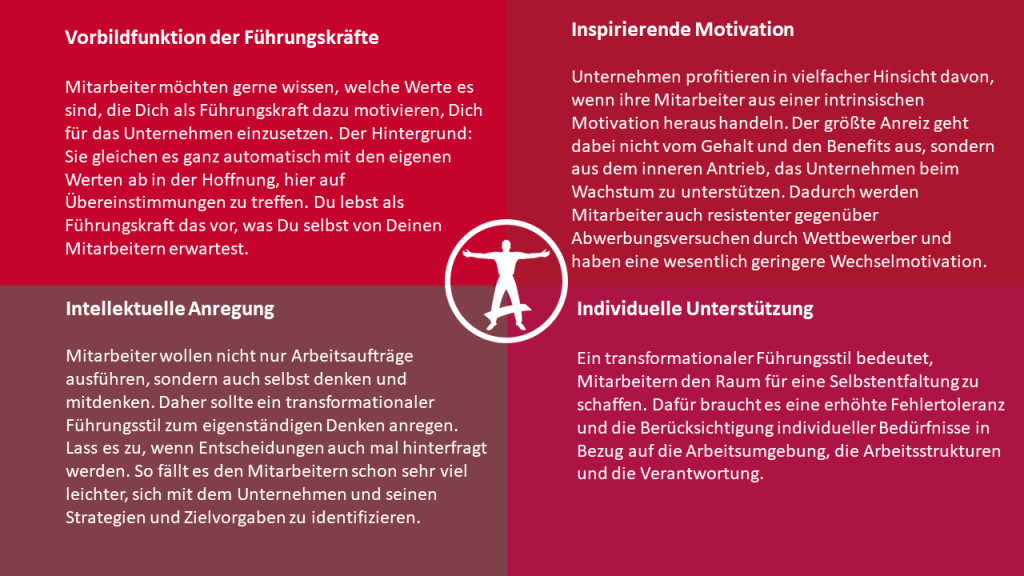
The model was developed by observing successful managers. They managed to positively influence the behavior of their employees through their role model function and their authenticity. As a result, employees became more loyal and showed greater commitment and self-discipline than employees who were under directive leadership.
The objective of transformational leadership is to build a solid foundation of trust between the supervisor and the employees. This is the only way to create an environment in which each individual can develop and build on his or her own strengths and approach the solution of various problems with confidence. Ultimately, this form of leadership inspires employees to think and act in an entrepreneurial manner.
Values are an important anchor point in a company. However, they cannot be prescribed in an employment contract, nor can they be communicated via the bulletin board in the coffee kitchen. Values must be lived and exemplified by the manager.
Transformational leadership is considered the perfect leadership style for dynamic work environments. There are now numerous studies that prove the benefits of this leadership style in practice. Employees have been shown to be more creative in a transformational work environment, have greater trust in their leader, and also feel greater self-efficacy. This also results in less stress and greater self-commitment to their tasks and responsibilities. Some companies can even directly attribute increased sales to their transformational leadership style.
In almost every industry today, it is important to think innovatively and respond flexibly to the rapidly changing competitive environment. When decisions are made only on a desk, major barriers are created in terms of the time factor. In addition, the existing resources that employees naturally bring to the table are not used effectively. With a transformational leadership style, you can achieve changes in employee behavior that increase engagement and productivity.
Challenges arise from transformational leadership especially when the values and attitudes of the leader differ significantly from those of the employees. In addition, there may also be differences between the values and views of the employees themselves. In such cases, a great deal of understanding and empathy must be shown on both sides. In addition, it is often challenging in practice to place employees on an equal footing while still responding to their individual needs. This sometimes creates the impression of injustice in the team.
A transformational leadership style can only be successfully put into practice if the manager is not too involved in operational business. She should mainly be concerned with her leadership tasks. Transformational leadership can also become a challenge if there is a lack of direct contact between the leader and the employees. If teams primarily work remotely or in home offices, it can be difficult to communicate values and ideas via digital channels.
Resistance is to be expected with transformational leadership
The goal of transformational leadership is to change attitudes. Resistance is therefore to be expected. Therefore, plan sufficient resources to be able to deal with these resistances individually.
One of the most important characteristics of transformational leaders is self-reflection. Regularly check yourself to see whether you can fulfill the demands you place on your employees. Be aware that your actions and thoughts are perceived by others and that you should always keep your role model function in mind. This is particularly evident in situations in which you have to resolve conflicts or make difficult decisions.
Transformational leadership requires a strong sense of self-awareness on the part of the manager. Uncertainties are immediately perceived by the team. For many managers, this means that they must first develop themselves and acquire the necessary skills.
We would be happy to support you in this challenge within the framework of coaching and seminars!
A management style should always be chosen in such a way that it has long-term benefits for all involved. It is not only about maximizing profits, but also about setting up a motivated team that is committed to the company's interests out of a high level of self-motivation. For the company, this means: Higher productivity, more agility and, as a result, better figures in the end. Within the framework of a transformational work environment, employees can realize their own potential and are more satisfied, more motivated and less ill.
Leaders can build a better relationship with their employees through their role model behavior. They have less stress, more energy, can rely on their team and thus have more time to work on their leadership style. Ultimately, a well-implemented transformational leadership style is a win-win situation for everyone involved.
Are you enthusiastic about the benefits of the transformational leadership style and would like to successfully establish this effective methodology for more satisfaction and greater agility in your company? Then we would like to give you some tips on how you can apply the transformational leadership style in practice.
While there are concrete guidelines for other leadership styles, there is unfortunately no patent remedy for implementing the transformational leadership style. The most important thing is to create the conditions for successfully establishing this form of leadership in the first step.
Finally, an important prerequisite is the personality of the manager. He or she should not only master the craft of management, but also have suitable personality traits. These are difficult to change retrospectively. If a leader has narcissistic traits, for example, even the best intentions will be of no use. Leaders with such personality traits tend to be unsuitable for a transformational leadership style.
There is no master plan or to-do list for implementing a transformational leadership style that you simply check off. But there are some important tips that you should generally keep in mind when implementing it.
Step by step introduction
It makes little sense to set a day X on which implementation is to take place. A leadership style is not a piece of software that can be turned on and off with the push of a button. It is better to implement new leadership styles step by step and first select an area in which you will begin implementation.
Setting goals
How can you tell whether the new management style is bearing fruit and whether the first successes are being achieved? To do this, you should set clear goals and key figures. In addition, you should know exactly which competencies are still missing in order to successfully implement the goals.
360-degree feedback for leaders
360-degree feedback for leaders is particularly important in the transformation phase. It is perfectly normal if not all the competencies required for transformational leadership are present from the outset. It is therefore important to conduct a thorough strengths and weaknesses analysis, which can take the form of employee surveys, supervisor or customer feedback, for example.
Define your personal development plan
Once you have identified your weaknesses, you should create a personal development plan. This plan specifies what you can do to overcome your weaknesses as a transformational leader. A distinction can be made between short-term and long-term goals. After a certain period of time, you should always check your success in order to make small course corrections if necessary.
In practice, the situation sometimes presents itself in such a way that a different management style is practiced across the board, especially in large companies and corporations. Nevertheless, you can introduce many transformational competencies into your area of responsibility. There are not always clear boundaries here where one leadership style ends and the other begins. Always look for what is feasible, test the effectiveness and enjoy the successes.
To sum up: Transformational leadership requires leaders who are confident and demonstrate strengths in delegation skills and conflict management. It is also important to take the role model function seriously and to exemplify exactly the values and characteristics that you expect from your team.
You can learn or further develop these skills in the form of personal coaching sessions. On our coaching platform, you will find special offers with which you can find your topics and work on them together with your personal coach. Our professionals accompany you very individually, give you feedback and practical tips with which you can internalize the relevant transformational leadership competencies.
Get all the important information about the course content, schedule, and registration. Upon request, we can tailor this information to the training program you're already interested in.
You need to load content from reCAPTCHA to submit the form. Please note that doing so will result in data being shared with third-party providers.
More InformationYou are currently viewing placeholder content from Turnstile. To access the actual content, click the button below. Please note that doing so will result in data being shared with third-party providers.
More InformationYou are currently viewing placeholder content from reCAPTCHA. To access the actual content, click the button below. Please note that doing so will result in data being shared with third-party providers.
More Information