

The term "team development" is increasingly becoming part of the jargon of the working world. But this was not always the case. It is only in recent years that companies have been investing more and more in the further development of their own teams and have become increasingly concerned with the phases of team development.
We understand the phases of team development as a process that teams go through in their development. This specifically pursues the management and improvement of cooperation and other goals through concrete measures.
As this sentence makes clear, one of the most important goals is to strengthen cohesion within the team. After all, only a strong team will be successful in the long term. What this means can be easily illustrated using the communication square developed by communication psychologist Friedemann Schulz von Thun. In his theory, he describes how people communicate on four different levels and receive messages on four different levels. The relationship and factual levels are of particular importance here.
This shows how I feel about the other person and what I think of them. This kind of relationship information is conveyed through the way I formulate it, my tone of voice, facial expressions and gestures. At the factual level, on the other hand, the focus is on factual information. This is about data, facts and circumstances, which can be true/untrue, relevant/irrelevant or sufficient/insufficient.
The aim is to emphasize that the factual level can only function if the relationship level in the team is right and the people involved understand each other well. However, if the relationship level in the team is disturbed, there are also communication problems at the factual level.
This is precisely where measures such as team development in the company come in.
In the course of putting together a team, the team goes through four different phases of team development can always play a decisive role.
This means that the first team-building measure can already take place in Phase 1: Forming (group formation). The main aim here is to get to know each other and build up the necessary trust for good cooperation.
Phase 2: Storming Each member of the team begins to mark out their territory and thus delineate tasks and roles. This may well lead to initial conflicts and confrontations.
Once the team has found and defined its roles and tasks, organizational topics and internal processes must now be developed or revised. The aim here is to set common goals. In this phase, cross-team visions are often taken up in order to clarify the goal of the collaboration.
Phase 4: Performing Here, the defined processes and procedures are firmly integrated into everyday life, while the employees are highly motivated in their work. At this point, individual measures such as coaching or training can be used to provide support.
In summary, it can be said that a team can only achieve great results if the relationship level in the group is right. This does not mean that there is harmony throughout the team. Rather, it is about being on the same level and being more than just a group - namely ONE TEAM.
The result of a functioning team is to create trust & cohesion and achieve goals effectively. So-calledFLOW teams. The following diagram shows the 5 levels of success that make up these FLOW teams.
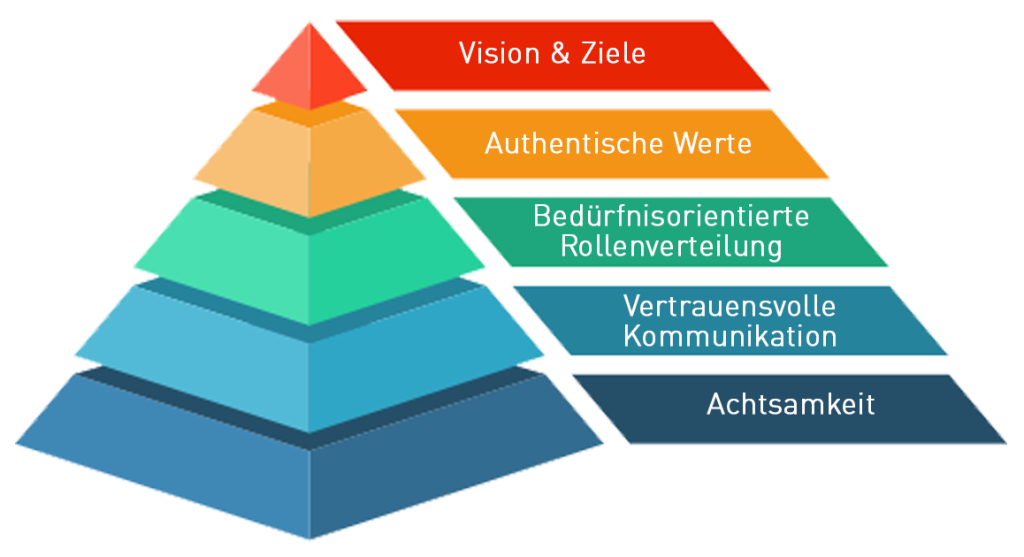
Hosang explains that a FLOW team can only come about if all five levels are lived with the necessary trust. If there is too much human tension in the team, this does not lead to flow, but to frustration.
At the first level is mindfulness. This means that there must be individual clarity about one's own feelings and those of others in order to create a healthy approach and clear interaction with one another.
Another important aspect of good cooperation is trusting communication, which is achieved by actively listening and creating a safe atmosphere for discussion.
With regard to the distribution of roles, it is important to ensure that these are distributed among employees in line with their needs. Only through the so-called best fit can it be achieved that the team members are motivated and can flourish in their role.
If we look at the company itself, it is of course important that the individual members can identify with the company values and feel valued and treated fairly.
If the "FLOW mood" exists at all the levels described, the whole team is ready to achieve visions and goals together.
How is it with you? Are you still a group or already a team? 😉
If you are interested in team building, then get in touch with us.