

Leadership has undergone a major transformation in recent years. Whereas just a few years ago, managers set the course unchallenged and had to make all decisions themselves, the core tasks have changed significantly. As a leader, you are no longer above your team, but have become a part of it. Above all, however, the digitalization push has essentially contributed to the role of managers shifting and new core competencies becoming important. In the following article, we have summarized the tasks that are now pending with regard to digital leadership.
Digital leadership refers to a new type of management style that has emerged as a result of the digital transformation. Modern companies are increasingly moving away from office hours and creating new framework conditions for their employees. They are using digital change to break out of old structures through innovation.
Employees are given the opportunity to better combine their private lives with their professional tasks. They can also work more efficiently and, for example, support a project from home or continue working on tasks during a long train journey.
Hierarchical leadership no longer works for virtual teams. Hierarchical management structures are often still found in large corporations, where decisions are traditionally made "at the top". Those who manage employees digitally must inevitably give their employees freedom and involve them in important decision-making processes.
Continuous change processes mean that new decisions have to be made all the time. Adhering to the hierarchical understanding of leadership would mean that all important decisions would have to be made at the manager's desk. This in turn would severely disrupt the speed of all work processes.
The increasing complexity in all areas makes it almost impossible for a single person to keep an eye on everything. Now it's time to hand over responsibility, create competencies and have confidence in the decision-making ability of team members. Handing over responsibility changes the entire leadership process and gives rise to new core tasks. Instead of leading in the traditional sense, new tasks arise for leadership.
Two approaches or models for digital leadership have now emerged that can support you in your day-to-day employee management. Both models have a different focus, which is why we would like to introduce them to you here.
This model is designed to help you set clear goals for your employees. You can then use whether and how these goals are achieved to measure the success of your management style.
The VOPA model focuses on trust. Such trust is particularly important in digital teams and when working from home, when attendance and punctuality are no longer used as evaluation criteria for employees.
This model can be expanded to include the plus component. This plus stands for trust as a central element of digital leadership. This model can only be put into practice if you have trust in yourself as a manager and in your employees.
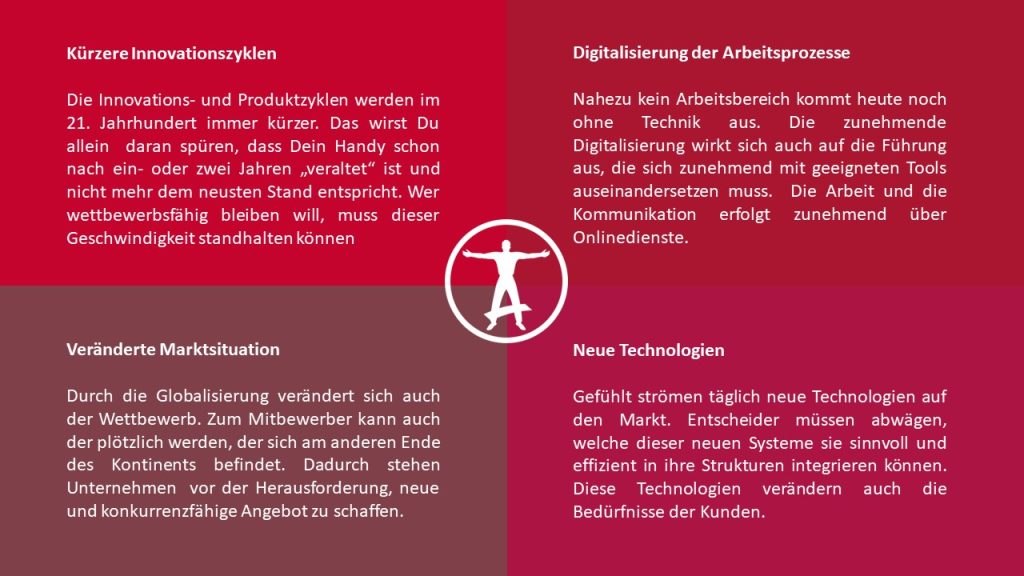
The digital age brings challenges for everyone. As digital leaders, managers in particular are confronted with special changes that also have an impact on their leadership style. Essentially, there are four areas that are literally being turned inside out by digitalization.
Digital leadership means that you lead your employees without physical proximity. You are therefore faced with the major task of creating a sense of togetherness between people who may never have met in person before. As a result, spontaneous meetings are no longer possible and performance appraisals become more difficult.
Leaving the house in the morning, going to work and meeting colleagues: What was once taken for granted is increasingly disappearing for many people. In particular, people who live alone and without a family are easily driven into social isolation by working from home and remotely. Digital leadership must also take this factor into account. People who work from home feel lonelier and often no longer part of the whole. Direct feedback is missing, as is contact with colleagues.
Digital leadership means not only organizing an exchange of information via communication tools and video calls, but also keeping an eye on the very personal exchange across work topics. Regular lunch meetings for half an hour can work wonders.
Not everyone is born with self-management skills. Whereas in the past, colleagues or managers who were present ensured that work was concentrated, now it is easy to be distracted by the dog, the smartphone or the soccer match that is about to be broadcast on TV. It is important for successful digital leadership to ask very close questions about work results and to provide feedback just as quickly.
One topic hovers over everything: digitalization. The digital transformation is not only changing the way we work together, but is also shaping the role that managers play in this new way of working. Teams working together virtually is increasingly becoming part of everyday life in companies. In digital leadership, the role of the manager is mainly defined by the use of tools, software skills and the organization of meetings. This new leadership task requires a new mindset that fundamentally revolutionizes the understanding of leadership.
Digitalization brings with it a whole mountain of new opportunities, but is also fraught with risks. Digital leadership must therefore have a corresponding willingness to take risks so that potential can be discovered and exploited. Anyone who automatically assumes that every new opportunity involves too much risk is stifling the spirit of innovation.
This goes hand in hand with a new culture of error; employees must be given the opportunity to test themselves in the midst of new developments in order to learn in a fear-free environment. The digital leader must live and exemplify this openness to mistakes themselves. He is a role model for employees and shows that mistakes are allowed to happen because they ultimately advance the team and the learning process.
Digital leadership is synonymous with flexibility and agility. Fear of making the wrong decisions and clinging to old structures hinders digital transformation and blocks the way for new work processes and business models. The approach is to learn from new experiences as quickly as possible and apply them to new work processes and business models.
Modern applications, software and tools are available to help you master the aforementioned challenges that digital leadership entails. Which of these is best suited to you and your organization ultimately depends on the processes and the type of projects you want to tackle in the digital space. Below you will find some suggestions on how you can shape digital leadership with the help of various tools.
Digital software creates the best conditions for more efficient processes, transparent communication in real time and enables centralized data access. They have therefore become an integral part of New Work and digital leadership. It is important to train all employees in the use of these tools so that they can actually be used effectively.
With the increasing digitalization and technologization of the world, completely new demands are being placed on management. Today, teams no longer work together in one office, but remotely in very different locations. Digital leadership must manage to establish a sense of togetherness, avoid social isolation and strengthen and encourage employees in their self-management.
As a leader, it is important to expand and develop your leadership skills in this direction. If you still need support with this, our coaches and advisory services are available to you at any time.
Get all the important information about the course content, schedule, and registration. Upon request, we can tailor this information to the training program you're already interested in.
You need to load content from reCAPTCHA to submit the form. Please note that doing so will result in data being shared with third-party providers.
More InformationYou are currently viewing placeholder content from Turnstile. To access the actual content, click the button below. Please note that doing so will result in data being shared with third-party providers.
More InformationYou are currently viewing placeholder content from reCAPTCHA. To access the actual content, click the button below. Please note that doing so will result in data being shared with third-party providers.
More Information