When companies change their strategy, restructure departments, or fill leadership positions, day-to-day operations should continue as smoothly as possible. After all, customers won't wait for a reorganization to be completed.
For teams, this means they have to make decisions and work together even though some issues are still unresolved. This is exactly what reveals how resilient their collaboration really is.
Team stability doesn’t mean that everything has to stay the same. A stable team is one in which people—even during times of change—understand what’s important, what they’re allowed to decide for themselves, and when they need support. In such a team, risks are addressed before they become problems. Conflicts may take time, but they take significantly less time than spending weeks avoiding them.
Leadership cannot eliminate uncertainty outside the team. However, it can prevent that uncertainty from creating a permanent state of limbo within the team.
Anyone who wants to lead teams through change must therefore do one thing above all else: provide guidance in day-to-day operations. A new organizational chart is of little help if no one knows which decision is currently in effect. Much more important are clear lines of responsibility, open and honest communication, and leaders who stand by their decisions.
Stability is demonstrated by a team's ability to remain functional even in the midst of change.
During turbulent times, leaders often try to reassure people first. That’s understandable. Statements like “Not much will change for you” or “We’ll let you know as soon as everything is settled” are meant to provide reassurance. However, if a lot does end up changing later on—or if answers are delayed for weeks—the opposite happens. The team ends up focusing on speculation instead of being able to concentrate on their work.
Employees pay very close attention to what happens after an announcement.
The answers to these questions shape trust more than any well-crafted message. If they are not provided, informal channels and personal interpretations will emerge. Even a very friendly atmosphere is no guarantee of effective collaboration. Sometimes it simply means that no one is addressing the difficult issue. The problem is not the conflict itself, but the conflict that everyone is avoiding.
We see this time and again in leadership teams: A decision is unanimously approved during a meeting. The next morning, additional emails and one-on-one conversations follow, along with requests to double-check the decision. Those involved aren’t necessarily opposed to the decision; they simply want to avoid being the only ones held accountable for it later on. Thus, out of caution, a surprisingly rigid decision-making system emerges.
This is where psychological safety comes into play. It refers to the experience of being able to openly address a differing opinion, a mistake, or bad news without being personally criticized for it. This leeway is especially necessary when many tasks are interdependent. A leader who only learns about problems once they can no longer be hidden may have a polite team, but not one that is particularly resilient.
This is not a counterproposal to high performance standards. On the contrary: Those who hear objections early on can respond sooner. And those who don’t have to worry about their reputation right away after making a mistake are more likely to help correct it.
Change alone does not make a team unstable. Things become difficult when, at the same time, the team loses its sense of direction, the legitimacy of leadership becomes unclear, and no one knows where to find the capacity to handle all the additional tasks. We encounter these three disruptions particularly often.
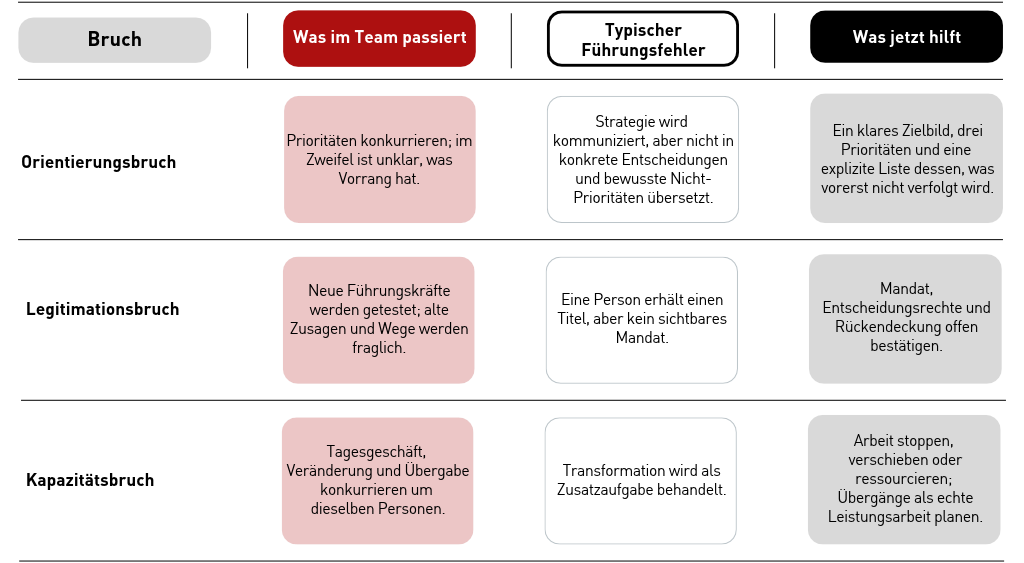
It’s easy to frame this as a matter of personal attitude: the team isn’t resilient enough, or the leader needs to communicate better. Sometimes that’s true. Often, however, it’s worth taking a closer look at the working conditions. Overlapping initiatives, conflicting reporting lines, or contradictory directives cannot be resolved simply by having more confidence.
This is particularly evident during leadership transitions. The new leader sets initial priorities. At the same time, the predecessor remains an important point of contact for long-time employees. Anyone who wants to be sure will check with both of them. No one necessarily has bad intentions. Nevertheless, this creates two paths to a decision, and the team quickly learns to wait and see.
That is why leadership should start with addressing avoidable ambiguities: identifying priorities, clearly defining responsibilities, and determining what work can actually be accommodated within available capacity. That may sound unspectacular, but in practice, it takes a huge weight off your shoulders.
Collaboration works better under pressure when certain rules have been established in advance. Not as a list of values, but as a shared agreement for difficult situations: What do we do when goals conflict? How do we handle disagreements? Who makes the decision when time is of the essence?
Six Collaboration Principles have proven to be a helpful framework for this. They are intentionally worded simply. The key is whether you can tell, in a specific situation, that a team is actually adhering to them.
Of course, it’s nice when everyone agrees. But a leadership team can’t spend so much time discussing every decision until no one has any reservations left. Sometimes one person has to make a decision after careful consideration. Everyone else then needs to know what has been decided, what options remain, and what will not be pursued further.
A clear decision is often more helpful than another round of discussion in which everyone seems to agree.
“Clarity before consensus” does not mean stifling criticism. On the contrary: Before a decision is made, the relevant counterarguments should be laid out on the table. Afterward, however, a commitment is needed. In many meetings, something else happens: An issue is officially considered decided, only to resurface two weeks later virtually unchanged. Often, there is no shared understanding of exactly what the decision resolves.
A simple decision log can help with this. It documents what was decided, who is responsible for it, why the decision was made, which interfaces are affected, and when they will be reviewed. It doesn't have to be a complex system; a well-maintained shared document is often sufficient.
A practical test: Would the two parties involved describe the decision in exactly the same way the next day?
People who work closely together occasionally clash. That isn’t necessarily a sign of a poor team culture. When speed and attention to detail, local interests and shared goals, or day-to-day operations and change management come into conflict, real tensions arise. These cannot be resolved through polite silence.
The second principle therefore calls for objections to be discussed where they can be addressed—and in a timely manner. Not in a private conversation after the meeting, not as a snide remark in the hallway, and not as silent resistance during implementation.
A common pitfall lies with the leader herself. She explicitly asks for counterarguments, but then immediately responds with an explanation of why the chosen course of action is the right one. Even if this is objectively justified, the team picks up on a different message: criticism is only welcome as long as it doesn’t lead to any changes. After a few such experiences, team members become less likely to speak up.
It’s more helpful to ask questions first and understand the implications of an objection. It’s also okay to admit that you’ve overlooked something. A statement like, “I hadn’t considered that point; let’s take a look at it,” doesn’t undermine your authority. It shows that a discussion serves a purpose.
What concern is your team likely to bring up only after it's already too late?
As soon as the situation becomes uncertain, the number of people copied on a decision often increases. Emails become more detailed, decision-making takes longer, and even minor questions get escalated one level up the chain of command. This is often not due to a lack of willingness to take responsibility, but rather to a concern about making oneself vulnerable under changing circumstances.
We need a reliable framework here. Anyone with a mandate should be able to make decisions within that framework. Anyone who needs support should escalate the issue in a targeted manner—ideally with their own proposal. And anyone who identifies a risk should not only point out the difficulty but also be able to suggest what the next logical step would be.
This becomes particularly delicate during a leadership transition. The new leader must have the opportunity to take effective action on their own. The previous leader can pass on valuable experience but should not become a second decision-maker. This often happens unintentionally: through a comment over coffee, a quick question, or a well-intentioned suggestion to someone they trust. Over the course of several weeks, however, the impression develops that important decisions still have to bypass or go through the former leader.
That is why succession planning is more than just filling a vacant position. It is also about relationships, unspoken expectations, influence, and the question of how an organization can transfer leadership responsibilities without losing its ability to act.
Where is there particularly thorough deliberation going on right now, even though someone really needs to make a decision?
Change creates a need for discussion. What often doesn't help is an ever-increasing frequency of status updates. Those who send daily updates but leave it unclear where priorities are being adjusted or conflicts resolved end up producing more information but little guidance.
It’s better to have a rhythm that the team can rely on. There need to be regular opportunities to assess the situation, hear objections, make decisions, and evaluate experiences. These meetings don’t have to be long or time-consuming. However, they must serve a clear purpose.
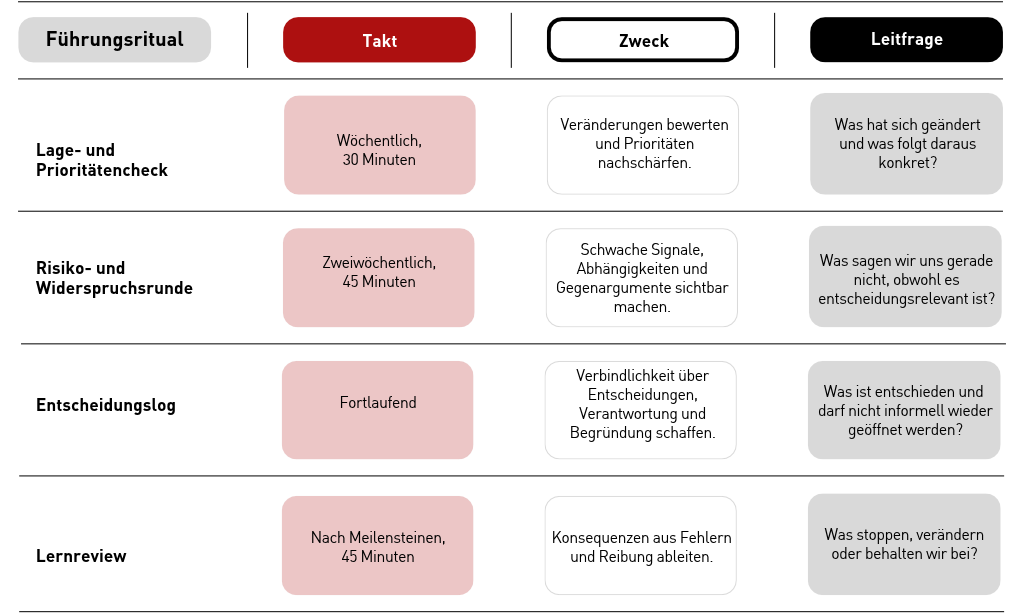
Many teams have had these types of formats for a long time: a weekly check-in, a risk review, a list of pending decisions, and occasional retrospectives. The problem is rarely the complete absence of meetings. What matters is whether these formats are interconnected. If a risk is identified during one session, it must be clear who will assess it and at which meeting a decision will be made, if necessary.
A good workflow takes the pressure off everyday life. Not every new question requires an immediate special meeting with ten people. The team knows where it belongs and can focus on implementation in the meantime.
What discussion are you having yet again without getting any closer to a decision?
Differing interests are a natural part of any organization. They become problematic when no one addresses them openly. When that happens, information is shared sparingly, those involved are brought in too late, or objections are raised outside of the designated discussions. It then becomes difficult for everyone else to understand what the issue is really about.
Transparency does not mean that every piece of confidential information must be available to everyone. Rather, it means making a clear distinction: What do we know? What are we assuming? Who is affected by a decision? And what, for good reasons, are we not yet allowed to say? An honestly acknowledged limit is more helpful than trying to cover up a gap in information with certainty.
In large organizations, even an unclear guest list can sometimes be enough to spark speculation about future power dynamics. The speculation may be unfounded. Nevertheless, its impact is real: people withhold information, wait for signals, or seek out their own avenues of access.
Leadership doesn't have to hide interests; rather, it must make decisions transparent. Who has the mandate? What assumption does the decision rest on? Where are the limits of transparency? The more clearly these questions are answered, the less room there is for rumors and tactical detours.
What important assumption is currently being implied without anyone having stated it?
When something goes wrong, people are quick to ask who is to blame. That’s only human, but it often does little to help identify the root cause. Perhaps some information wasn’t available, perhaps a warning sign was overlooked, or perhaps a process actually contributed to the error. These factors only become apparent when you take a closer look.
Learning does not mean absolving someone of responsibility. Deliberate misconduct must be treated differently than a knowledge gap or a poorly designed process. Confusing these two creates fear instead of trust. And a team that withholds unpleasant news out of fear wastes valuable time.
Retrospectives, too, are only helpful if they lead to action. After a grueling project, everyone can very plausibly explain why a particular difficulty was unavoidable. The more interesting question is: What are we going to change now? Perhaps a line of responsibility, a review loop, or a priority. What’s important is that someone is responsible for the change and follows up later to see if it’s working.
A lot depends on the manager’s initial reaction. Asking, “Who caused this?” usually leads to excuses. Those who, instead, first seek to understand what happened and what information was missing generally learn more. Only on this basis can we have a fair discussion about responsibility.
In what specific ways has your approach to work actually changed since your last major mistake?
A change in leadership affects more than just the names on the organizational chart. Practical questions immediately arise within the team: Will the strategy remain the same? Who will make decisions about resources from now on? Which commitments made by the previous leader still stand? And how will performance be measured in the future? As long as the answers remain unclear, people will base their actions on what they observe.
The new leader cannot dispel this uncertainty with a particularly well-crafted inaugural speech. A clear transition is more helpful. Which initiatives will continue? What will be reviewed first? What decisions will the new leader make immediately, and which will be made only after an assessment of the current situation? And which roles will the previous leadership explicitly no longer assume in the future? The last question, in particular, often goes unaddressed for too long during leadership transitions.
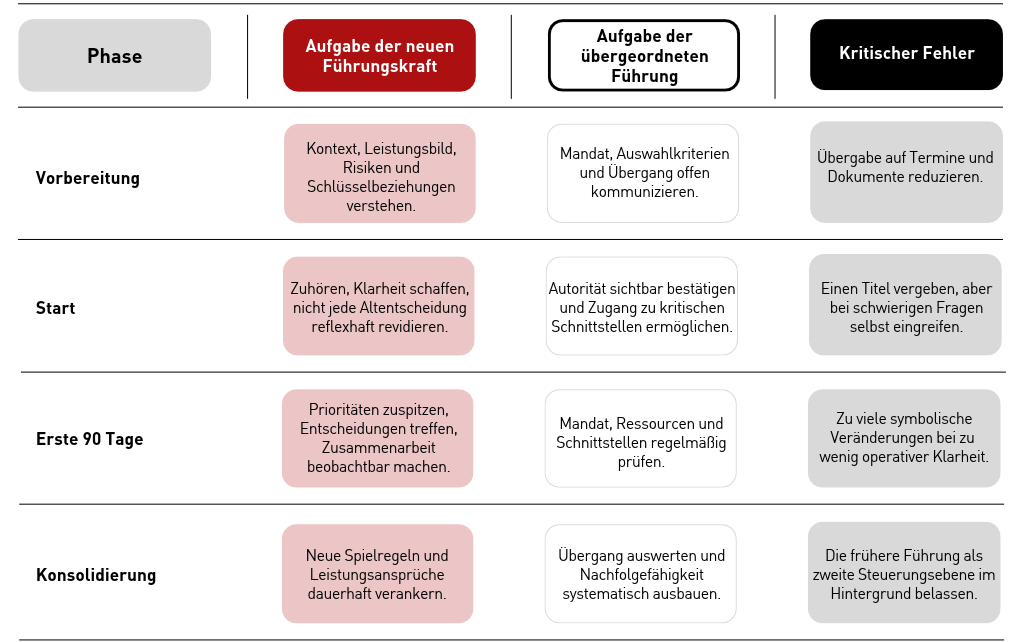
A one-page handover agreement can clarify a surprising amount here. It should include the strategic mandate, decision-making authority, binding standards, the remaining role of the outgoing leadership, expectations for the first 90 days, and a process for resolving contentious issues. It’s not the length of the document that matters, but rather that the parties involved can actually rely on it.
Such a transition not only makes it easier for individuals to accept the change; it also prevents old and new responsibilities from coexisting for months on end, during which time every important decision would have to be renegotiated.
The six Collaboration Principles don’t work just because someone presents them at a kick-off meeting. They only take effect in everyday life: when a leader lets critical feedback stand instead of immediately dismissing it; when a decision isn’t reversed behind the scenes; when responsibility remains where it belongs; and when a mistake is followed by a visible change.
Over time, this gives rise to something that cannot be mandated: the experience of being able to rely on one another’s cooperation. People know how decisions are made, when to speak up, and how to tackle a problem. This sense of reliability makes even difficult times more bearable.
You don't need to start a new transformation program to do this. Here are three things you can try as early as next week:
At the next team meeting, name three things that are a priority right now and, just as clearly, three projects that will have to wait for now.
For each pending decision, note who is responsible and by when a response is expected.
Set aside 30 minutes to address risks, dependencies, and objections. Start by listening before discussing solutions.
These small changes won't transform an entire organization just yet. But they quickly reveal where coordination has been time-consuming and where a lack of clarity has been hindering collaboration.
Anyone leading through a period of upheaval won't have a ready-made answer to every question. The more important task is to create conditions under which a team can still make good decisions.
That’s why it’s worth asking a different question than the usual one—whether employees have been sufficiently “brought along”: Can people here speak openly about what they see? Do they know what decisions they’re allowed to make? And are lessons actually learned from experience, even when it’s uncomfortable?
Anyone who doesn't have a clear answer to this question should focus less on finding the next communication strategy and take a closer look at day-to-day collaboration. Often, the difficulties stem from unclear mandates, unresolved conflicts, or too many projects running simultaneously.
Reliable leadership is demonstrated through small, sometimes uncomfortable decisions: putting a stop to something, truly delegating responsibility, tolerating an objection, or changing an established routine. This creates the breathing room that teams need in turbulent times.
A team remains stable not because everything stays the same, but because it has learned to function well even in the face of change.
Get all the important information about the content, schedule, and registration.
You need to load content from reCAPTCHA to submit the form. Please note that doing so will result in data being shared with third-party providers.
More InformationYou are currently viewing placeholder content from Turnstile. To access the actual content, click the button below. Please note that doing so will result in data being shared with third-party providers.
More InformationYou are currently viewing placeholder content from reCAPTCHA. To access the actual content, click the button below. Please note that doing so will result in data being shared with third-party providers.
More Information